
Note: Includes operation, on standby, or out of service (but not retired).
Data Source: Energy Information Administration; DOE Office of Electricity Global Energy Storage Database.
Analysis by CEC Economics
Highlights
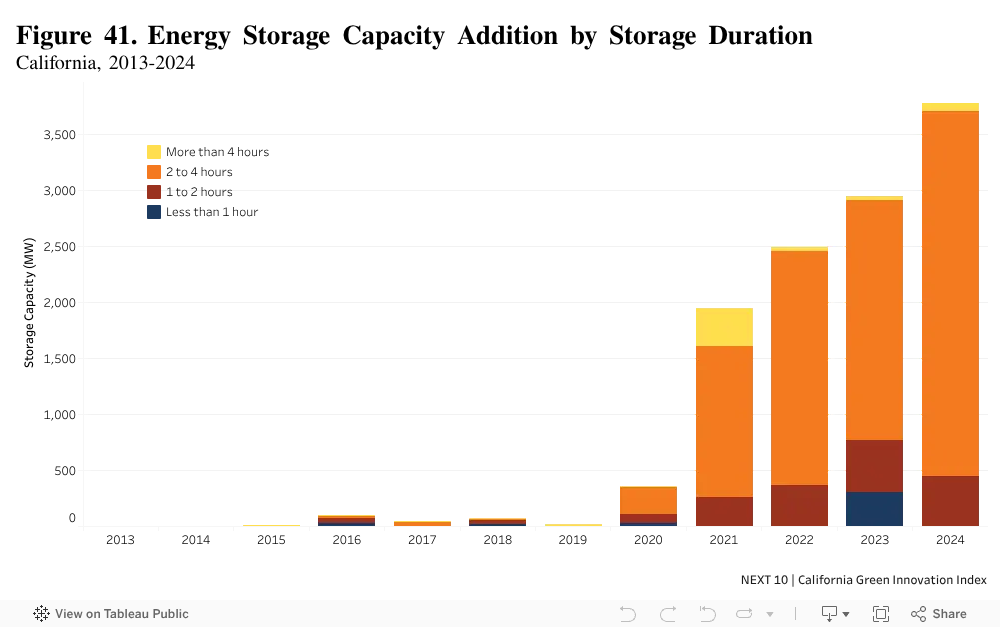
- The average storage duration for Li-ion energy storage systems that became operational in 2024 were significantly longer in California (3.6 hours) than the rest of the U.S. (2.3 hours), which is consistent with the historic trend. Systems with a duration of four hours were the most common in California, accounting for 77.1% (2,911 MW) of the state’s capacity additions in 2024. Although California is the leader in energy storage, the vast majority (98.1%) of the additions were for storage with a duration of four hours or fewer, which is similar to the share in 2023 (98.7%). Since energy storage, along with transmission capacity buildout, are important tools in mitigating the increasing solar and wind curtailment, the state needs to increase its procurement of longer-term duration energy storage.
More About
Renewable Energy
Related Content