International Scorecards
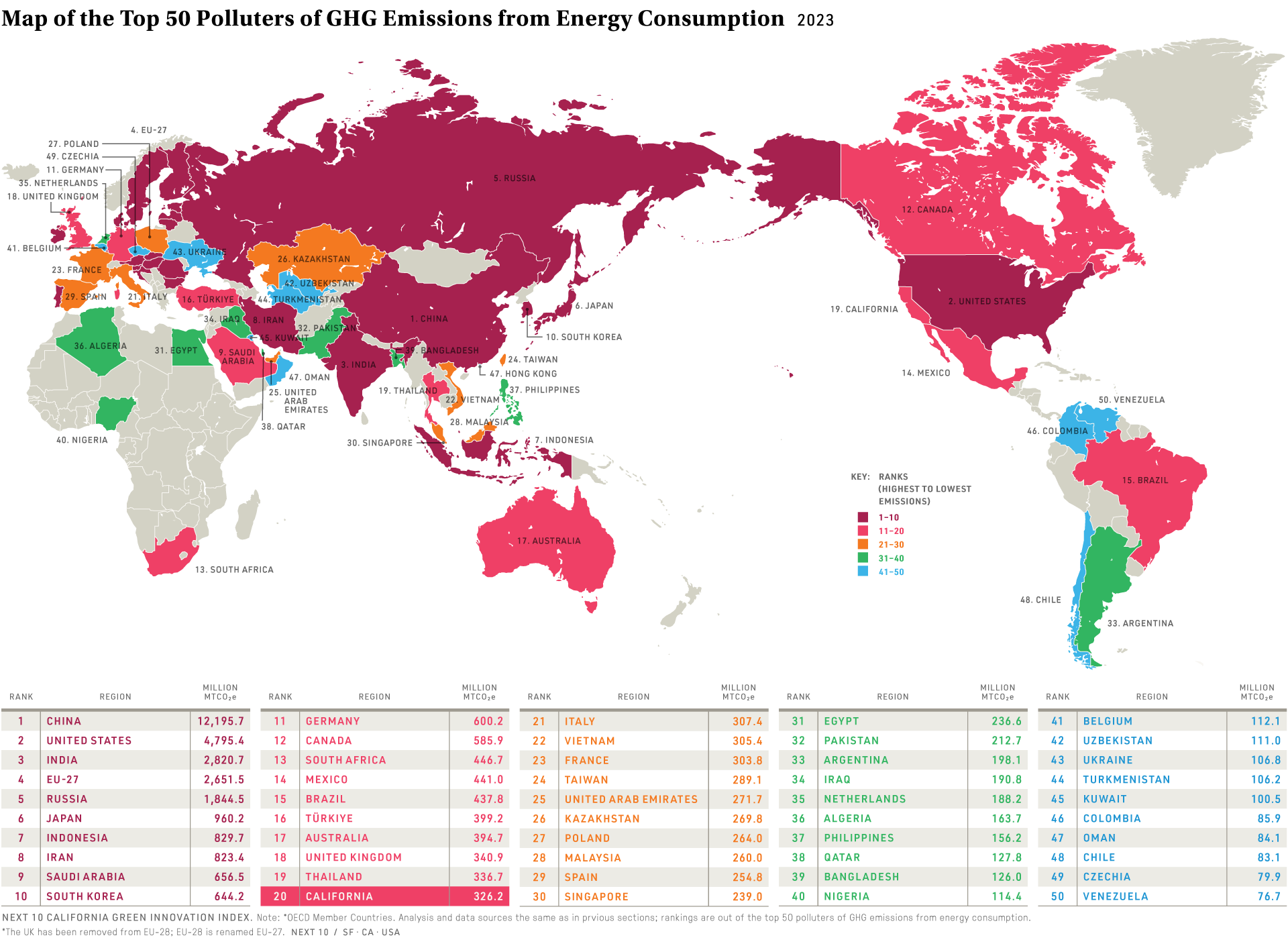
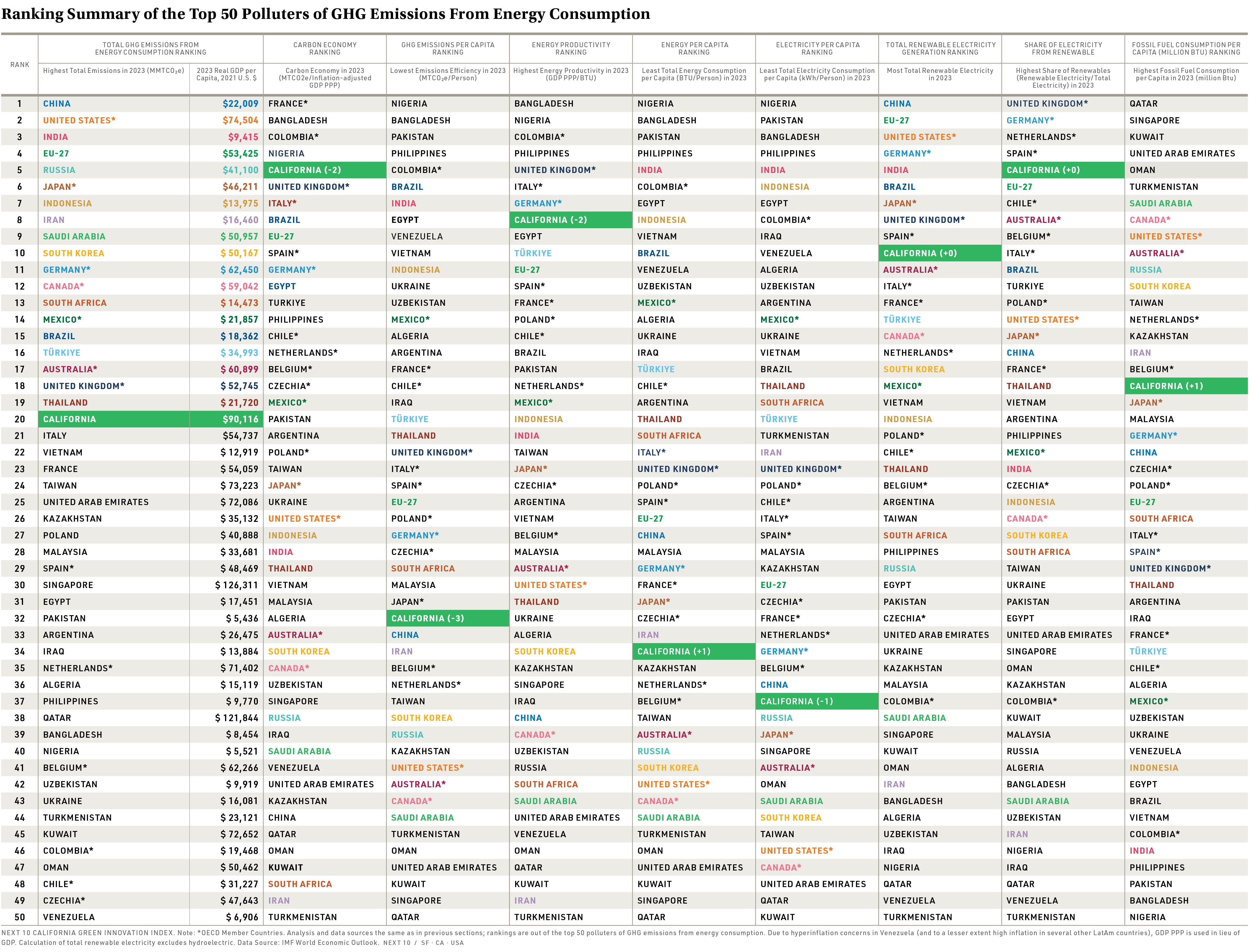
While California’s carbon emissions decreased from 2022 to 2023 — the latest year for which internationally comparable data were available — its carbon economy profile stayed the same or became worse in many cases, relative to the other top 50 polluters across the globe.
Despite California’s greenhouse gas emissions from energy consumption falling from the 19th to the 20th spot, indicating a cleaner energy system, California’s carbon economy ranking — emissions per inflation-adjusted GDP — fell to the 5th-lowest down two spots from 2022. Similarly, California’s electricity and energy consumption per capita increased in 2023, making the state the 17th- and 14th-highest in consumption per capita among the top 50 emitters, respectively. While California’s energy productivity remains high relative to other countries, it fell to the 8th-lowest, down two spots in 2023 compared to 2022. A higher energy productivity indicates that an economy is able to produce more economic output for each unit of energy consumed. Improving energy productivity is an important goal for many policymakers, as it can lead to cost savings, reduced greenhouse gas emissions, and improved energy security.
As California has struggled to reduce fossil fuel consumption relative to the top 50 emitters — increasing slightly from the 19th-highest to the 18th-highest for fossil fuel consumption per capita in 2023 — its total renewable electricity generation and the share of electricity from renewables remained unchanged from 2022 with the 10th- and 5th- highest renewable generation, respectively. In California, renewables make up an outsized share of electricity generation at 35% of total energy generation in 2023 compared to just 17% in the U.S. overall. Despite dropping three spots to the 32nd-lowest emissions per capita among the top 50 emitters globally in 2023, California’s carbon emissions per capita has seen a slow but steady decline over the last two decades at 8.4 MTCO2e in 2023, markedly lower than the U.S. at 14.3 MTCO2e.