
Data Source: California Air Resources Board, California Greenhouse Gas Inventory
Analysis by CEC Economics
Highlights
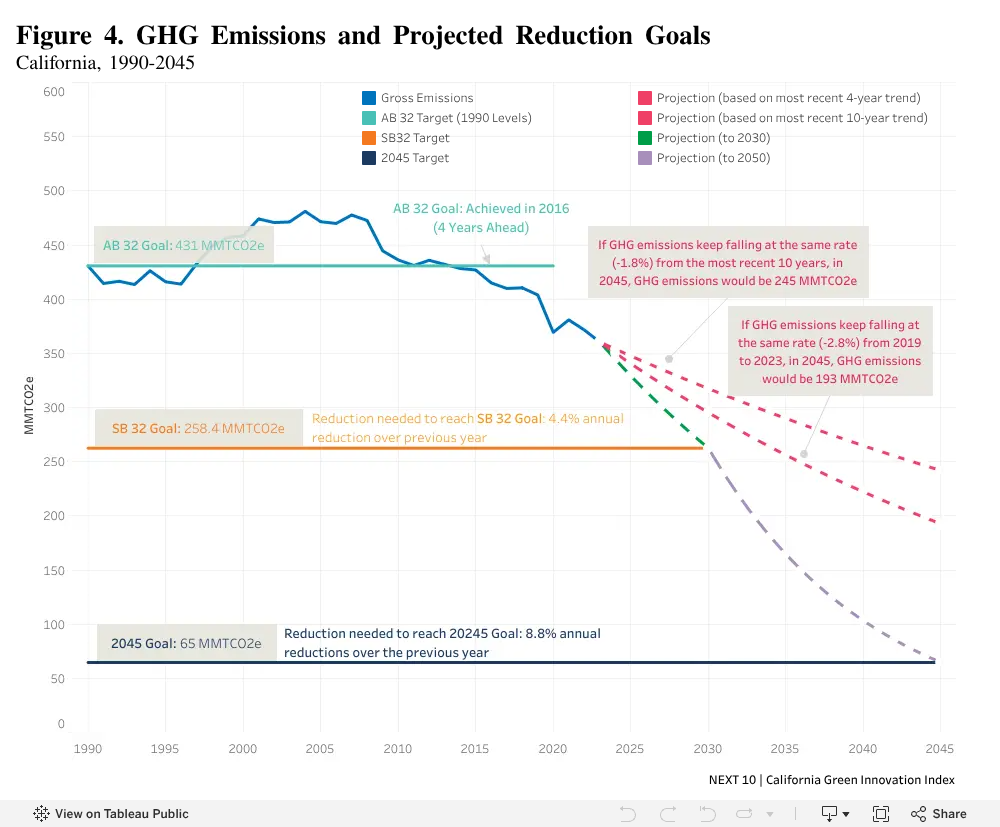
- From 2000 to 2023, GHG emissions decreased by 21.4% (-98.3 MMTCO2e). Furthermore, emissions had been falling at a faster pace since SB 32 became law in 2016, averaging 2.0% per year from 2016 to 2023 than from 2006 (when AB 32 became law) to 2016, which averaged 1.2% decline per year.
- California released the world’s first plan to achieve net-zero carbon pollution in late 2022 with the new Scoping Plan.6 The new roadmap revised the state’s previous 2050 emissions goal of 80% below 1990 levels to the new goal of reducing emissions to 85% below 1990 levels by 2045.7 However, even if California manages to meet the SB 32 target by 2030, to reach the goal by 2045, the state would need to reduce its emissions at a pace of 8.8%—more than double the pace required to meet the SB 32 target. However, using the recent five-year annual average reduction of 2.8%, emissions would need to decrease by 9.5% on average each year from 2030 to 2045 to meet the 2045 goal on time.
6 Office of Governor Gavin Newsom. California Releases World’s First Plan to Achieve Net Zero Carbon Pollution. November 16, 2022. Accessed October 3, 2024. Available at: https://www.gov.ca.gov/2022/11/16/california-releases-worlds-first-plan-to-achieve-net-zero-carbon-pollution/
7 According to California Air Resources Board’s scoping plan, the 85% emissions reductions will be achieved by cutting air pollution by 71%, reducing fossil fuel consumption by 86%, and reaching carbon neutrality by 2045. The scoping plan can be viewed here: https://ww2.arb.ca.gov/news/california-releases-final-2022-climate-scoping-plan-proposal
Challenges
- California is currently not on track to meet the SB 32 target of 40% below 1990 levels by 2030. The annual average reduction required to meet the SB 32 goal by 2030 is 4.4% as of 2023—more than double the average reduction from 2016 to 2023. Using the average annual rate of decline from 2019 to 2023 of 2.8%, the state will reach its SB 32 in 2035, five years behind schedule. Additionally, at that pace, California’s emissions would be three times more (193.0 MMTCO2e) than the goal of 85% below 1990 levels by 2045.
More About
Carbon Economy
Related Content