
Note: Includes operation, on standby, or out of service (but not retired). 2025 Data is preliminary (p) and data for 2026 and beyond are proposed (f).
Data Source: Energy Information Administration; DOE Office of Electricity Global Energy Storage Database.
Analysis by CEC Economics
Note: Includes operation, on standby, or out of service (but not retired). 2025 Data is preliminary (p) and data for 2026 and beyond are proposed (f).
Data Source: Energy Information Administration; DOE Office of Electricity Global Energy Storage Database.
Analysis by CEC Economics
Highlights
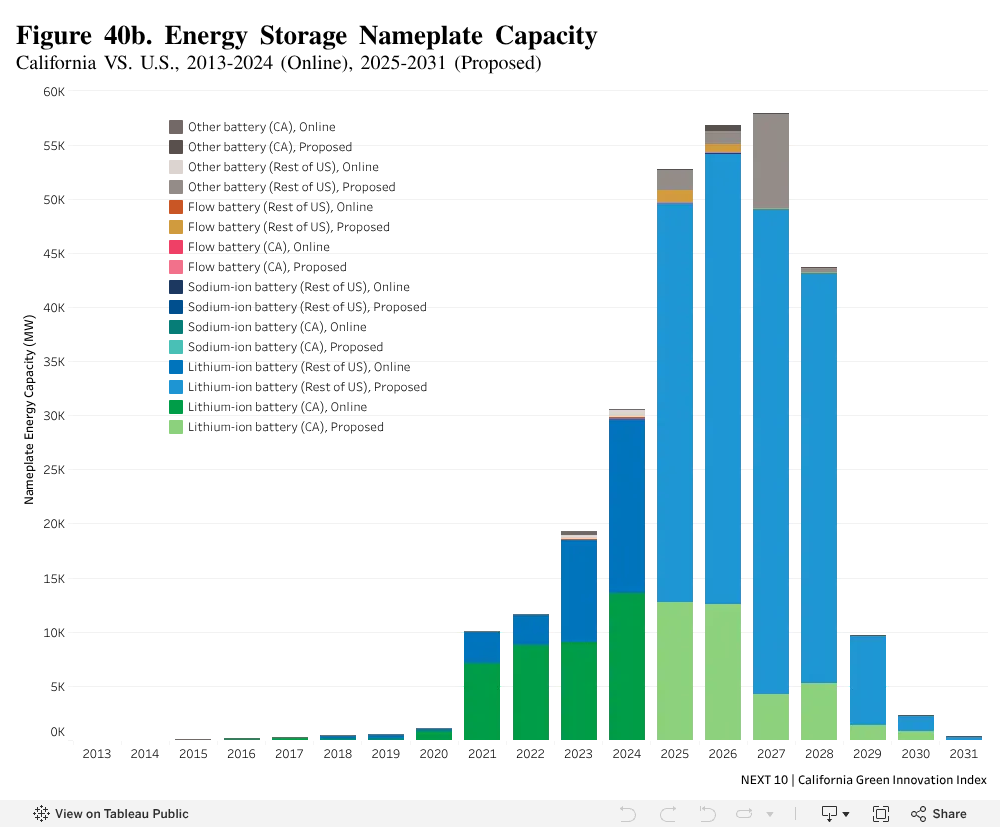
- In 2025, California added 3,388 MW of net operable energy storage capacity (all in lithium-ion batteries), down 10.3% compared to 2024; 2025 is the first year where California added less energy storage capacity than the prior year.84 This was partly due to the retirement of the battery storage facility due to the fire at Moss Landing in January 2025. Meanwhile, the rest of the U.S. added 12,792 MW (including 527 MW of non-lithium-ion batteries), an increase of 75.6%.85 Nationwide, most of the energy storage systems that came online in 2025 are composed of lithium-ion (Li-ion) batteries (96.7%).
- Looking ahead, the energy storage pipeline is robust for the near future. As of the end of 2025, California has 11,052 MW of proposed energy storage capacity in the pipeline for 2026 to 2031 while the rest of the U.S. has 57,380 MW of proposed energy storage capacity in the pipeline. Most of the proposed energy storage systems in the pipeline are expected to become operational between 2026 to 2028 — 9,834 MW in California and 49,843 MW in the rest of the U.S.
84 2025 data is preliminary and is subject to future revisions.
85 This excludes retired units. Additionally, these include only utility-scale energy storage systems. Whereas, the California Energy Commission’s California Energy Storage System Survey has capacities reported as low as five kilowatts (kW). This means the EIA’s data on Form 860 is not directly comparable with the CEC’s survey data.
Challenge
- On January 16, 2025, a fire at the Moss Landing Power Plant battery storage facility — the 300 MW first phase of Vistra’s energy storage facility near Santa Cruz, California — consumed about 55% of the facility’s 100,000 battery modules over the course of five days, resulting in the largest lithium-ion battery cleanup in the EPA’s history.86, 87 Moss Landing was subsequently retired in 2025 — just four years after it became operational in 2021. Since then, communities have been pushing back against the siting of battery storage facilities in their communities due to safety concerns, including a project proposed at 90 Minto Road near Watsonville.88 In response, Governor Gavin Newsom signed SB 283 into law that requires operators of battery storage facilities to receive approval from and coordinate with local fire authorities before a project can be approved.89
86 Brian Martucci. After Moss Landing, what’s next for battery storage? Utility Dive. February 28, 2025. Accessed October 28, 2025. Available at: https://www.utilitydive.com/news/moss-landing-fire-battery-storage-industry-lithium/741283/
87 Caroline Hemphill. Historic battery plant cleanup kicks off in Moss Landing. Mercury News. October 1, 2025. Accessed October 28, 2025. Available at: https://www.mercurynews.com/2025/10/01/historic-battery-plant-cleanup-kicks-off-in-moss-landing
88 PK Hattis. In wake of Moss Landing fire, Newsom signs battery storage safety bill. Mercury News. October 14, 2025. Accessed October 28, 2025. Available at: https://www.mercurynews.com/2025/10/14/gov-gavin-newsom-signs-sen-john-lairds-battery-storage-safety-bill/
89 CA SB283. Accessed October 28, 2025. Available at: https://legiscan.com/CA/text/SB283/id/3269002
More About
Renewable Energy
Related Content