Transportation

Transportation, California’s largest energy-consuming and greenhouse-gas-emitting sector, accounted for 38.0% of the state’s total GHG emissions in 2024, a decrease of 4.5% compared to 2023. Most of the decrease in emissions from this sector have been driven by reductions from the heavy-duty vehicles subsector, in which emissions fell by 17.5% from 2023 to 2024. This follows a reduction of 17.2% from 2022 to 2023 and is due to an increasing share of biodiesel being used instead of petroleum diesel. Meanwhile, emissions from passenger vehicles fell by only 1.4% and public transit ridership remained 22.0% lower in 2025 than the pre-pandemic level in 2019.

Californians purchased 80,932 new EVs in Q3 2026, accounting for 19.1% of new vehicle sales, and down from 86,857 new EVs in Q2 2026.27 This reflects an expected decline from the same period last year when sales spiked before the $7,500 federal EV tax credit was eliminated on October 1, 2025. In Q3 2025, a record high 29.1% of all vehicles sold in California were ZEVs.28 Of those, 28.3% were battery electric vehicles.29

Similarly, H.R. 1 eliminated a tax credit intended to boost EV charger installations on private property in rural or underserved communities.30 The Alternative Fuel Refueling Property Credit, which provided a 30% credit (capped at $1,000) for home EV chargers, expired beginning on July 1, 2026. The credit also covered the installation costs, electrical panel upgrades, and wiring necessary to support home charging, and the typical Level 2 charger installation costs between $2,000 and $3,000.31

However, it isn’t all bad news for EV charging. The 2021 federal Infrastructure and Investment Jobs Act included $5 billion for the National Electric Vehicle Infrastructure (NEVI) program that funds states to deploy EV chargers, covering up to 80% of costs, including charger acquisition, maintenance, and data sharing, along highways and other state-owned property.32 The Trump administration attempted to cancel the funding, but in June 2025 a federal court ruled that the freeze on the funding was illegal. As of early October 2025, at least 44 states and Washington D.C. had applied for funds under the program and at least 32 states have had their plans approved, including California’s in September 2025.33, 34 California also launched its own EV rebate program, The MyFirstEV program, to give first time EV buyers $3,500 off an electric vehicle right at the dealership.35

Transportation Emissions and Vehicle Ownership
  • GHG emissions from surface transportation decreased by 4.5% (or 5.6 MMTCO2e) from 2023 to 2024 despite rising VMT.

  • GHG emissions from surface transportation per capita decreased by 5.0% during the same period.

  • In 2024, VMT in California totaled 326.0 billion miles, up 9.3 billion miles or 3.0% from 2023, but remained 6.5% below the 348.8 billion miles recorded in 2018.

  • In 2024, emissions per VMT averaged 0.37 tons of CO2-equivalent per 1,000 vehicle miles traveled. Not only is this ratio the lowest it has ever been, it is also 13.2% less than in 2020 during the pandemic shutdown.

  • From 2023 to 2024, VMT per registered vehicle increased by 4.6% (469 miles) to 10,620 miles.

  • The vehicle ownership rate (excluding ZEVs) continues to drop, reaching a new low of 69.3% in 2025.36

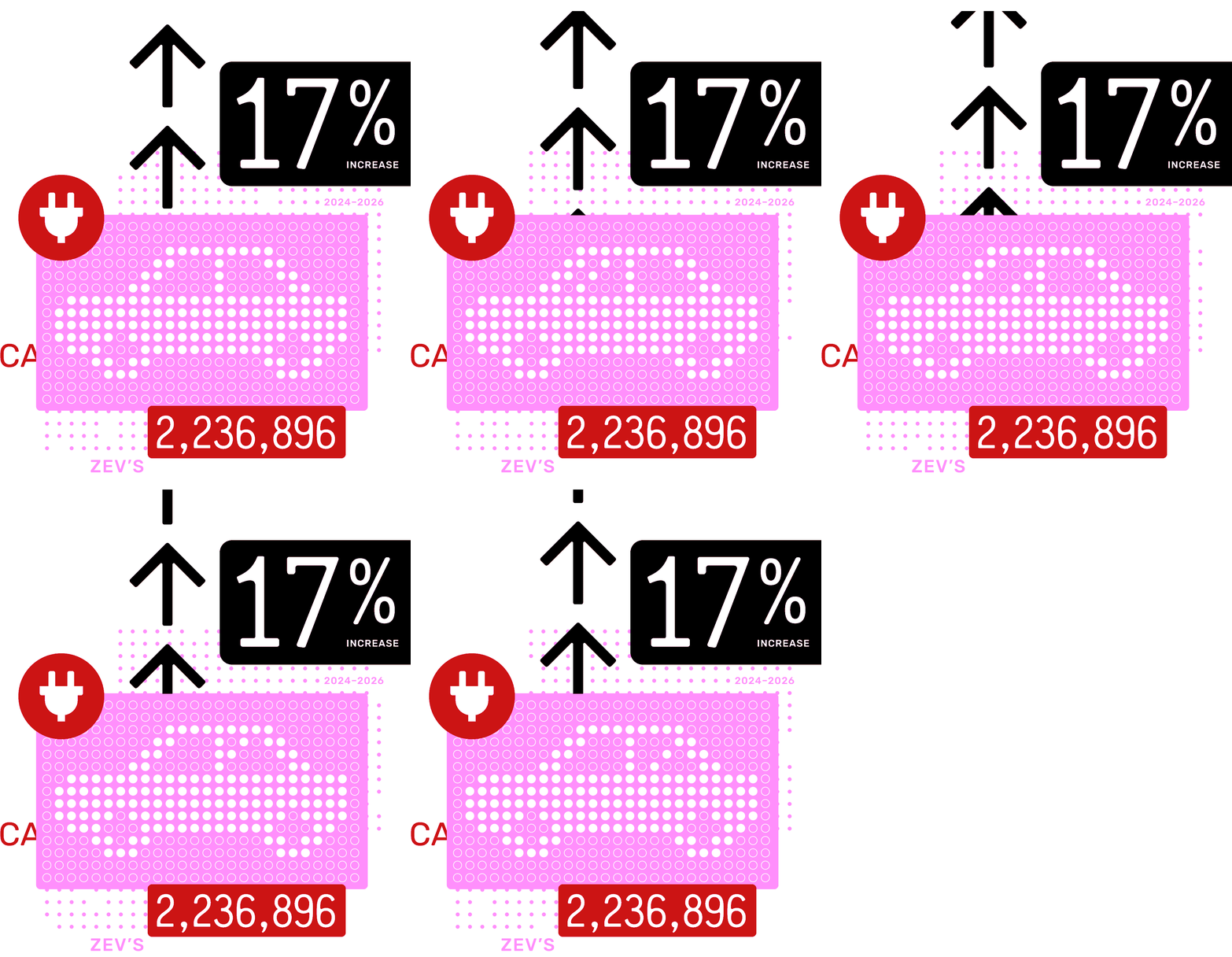
  • For the first time, the number of ZEVs registered (2,236,896) and the number of hybrid vehicles registered (2,080,015) both surpassed the two million mark in 2025. However, the number of HEVs registered grew faster (+18.3%) from 2024 than ZEVs (+17.7%).

  • In 2025, the share of new registrations from light-duty pickup trucks, mini-vans, and SUVs made up 74.3% of new light duty vehicle registrations—up from 72.4% in 2024.

  • In 2025, total light truck registrations increased from 1.27 million vehicles to 1.34 million vehicles (+5.7%) while car sales dropped 3.1% from 478,400 to 463,700 vehicles.

  • For the first time ever, new battery-electric vehicles (BEVs), plug-in hybrid electric vehicles (PHEVs), and fuel cell electric vehicles (FCEVs) registrations fell from 25.5% of total new vehicle registrations in 2024 to 24.4% in 2025.

  • At current trajectory, California is not on track to meet its immediate interim Advanced Clean Cars II (ACCII) goals of new ZEV sales at 35% for model year 2026.

  • In 2025, new BEV and FCEV registrations totaled about 377,600 vehicles, down 2.0% from the 385,500 new vehicles registered the previous year, reflecting the impacts of the expired federal EV tax credits.

  • New registrations of PHEVs grew by 4.6% in 2025 relative to 2024. Californians registered 63,600 new PHEVs, the highest figure since 2018.

Zero-Emission Vehicles
  • The number of ZEVs on-road in California totaled 2.24 million in 2025, a 17.7% increase from 2024. However, the growth is a slow down compared to 2024’s increase of 25.3% compared to 2023.

  • To reach the 2030 goal of 5 million ZEVs on-road, ZEV registrations in California need to increase by an annual average of 17.45% from 2026 to 2030, relatively unchanged from the 17.50% required previously between 2025 to 2030.

  • In 2025, 7.5% of registered vehicles on the road were ZEVs, up 6.5% from 2024.

  • The number of electric light-duty pickups, SUVs and vans registered surpassed a million units for the first time in 2025, with 1.24 million vehicles registered, up 28.7% compared to 2024.

  • Although electric medium- and heavy-duty vehicles (MHDVs) make up only a small sliver of all ZEV registration, registrations totaled 8,868 vehicles in 2025, an increase of 51% compared to the 5,857 registrations in 2024.

  • California’s EV charging network expanded rapidly in 2025, with 217,000 chargers by December 2025, double the number of chargers in December 2023 (106,000).

  • From February 2025 to December 2025, Los Angeles-Long Beach-Anaheim leads with 19,400 EVSE chargers added (+23%), followed by San Jose-Sunnyvale-Santa Clara with 6,600 EVSE chargers (+23%) and San Francisco-Oakland-Hayward with 2,500 EVSE chargers (+11%).

  • The state added more public DC Fast chargers (4,500) than public level 2 chargers (2,500) from February 2025 to December 2025.

  • EVSE chargers are being deployed most rapidly in metro areas with below average ZEV adoption rates. The number of chargers grew 63% in El Centro, 47% in Merced and Visalia-Porterville from February 2025 to December 2025.

  • San Jose-Sunnyvale-Santa Clara leads the state with ZEVs accounting for 13.7% of registered vehicles followed by San Francisco-Oakland-Hayward with 11.5%.

  • ZEVs make up over 5% of all registered vehicles in 15 (over half) of California’s MSAs.

Clean Transportation’s Future
  • As of June 15, 2026, there were 78,000 public Level 1, Level 2, and DC fast-charging ports in California.37 This amounts to just over 30% of the 250,000 public and DC fast charging (DCFC) shared chargers target by 2025.38

  • Motor vehicle fuel production of gasoline (-20.1%) and diesel (-40.3%) continued to trend below 2019 levels in 2025.39

  • Unlinked passenger trips (UPTs), which represent the number of times passengers board public transportation vehicles, remained 22.0% lower in 2025 than the pre-pandemic level in 2019.

  • Compared to 2024, production of gasoline fell (-7.0%) and diesel increased slightly (+0.8%), totaling 381.7 million barrels, down 22.2 million barrels or 5.5% relative to 2024.

  • California is steadily building up its supply of used ZEVs. In 2025, 1.8 million ZEVs registered were used, up 22% from 1.5 million used ZEVs in 2024 and over one million more used ZEVs compared to 2022.

  • Used battery EV (BEV) registrations were 1.4 million in 2025, up 25% compared to 2024’s 1.1 million and used plug-in EV (PHEV) registrations were 406,000 in 2025, up 15% compared to 2024’s 354,000.

  • The retention rates of used ZEVs have improved in recent years. The three-year retention rate of model year 2021 BEVs was 87% three years after when registrations peaked, a significant improvement compared to model year 2017 BEVs, which had a three-year retention rate of just 58% three years after when registrations peaked.

Footnotes

36 ZEVs are defined as battery electric vehicles (BEVs), plug-in hybrid electric vehicles (PHEVs), and fuel cell electric vehicles (FCEVs).

37 An EV charging port provides power to charge only one vehicle at a time even though it may have multiple connectors. A connector is what is plugged into a vehicle to charge it. Multiple connectors and connector types (such as CHAdeMO and CCS) can be available on one EV charging port, but only one vehicle will charge at a time. Connectors are sometimes called plugs.

38 The 250,000 target was established by Executive Order B-48-18 in 2018. California Governor’s Office of Business and Economic Development (GO-Biz). “Electric Vehicle Charging Station Permitting Guidebook.” 2nd ed. January, 2023. Accessed July 9, 2025. Available at: https://business.ca.gov/wp-content/uploads/2019/12/GoBIZ-EVCharging-Guidebook.pdf

39 The U.S. Department of Transportation’s Motor Fuel & Highway Trust Fund stopped publishing data after July 2023. As a result, motor vehicle fuel consumption data has been replaced by California Energy Commission’s Petroleum Industry Information Reporting Act (PIIRA) database.